Home » News » RFID in Manufacturing: An Automation and Efficient Factory Management Solution
RFID in Manufacturing: An Automation and Efficient Factory Management Solution
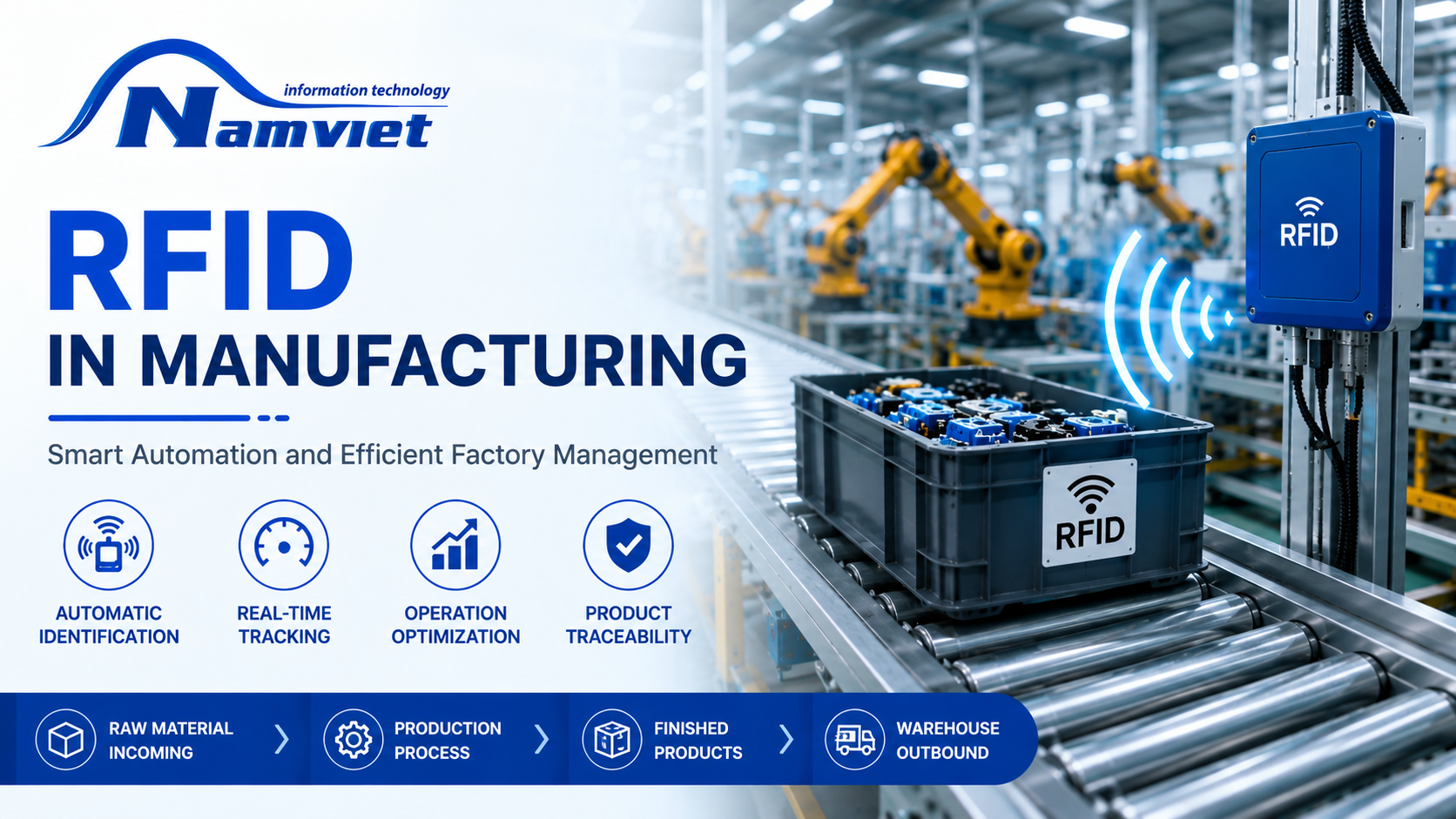
In real-world management, many manufacturing workshops still face hundreds of systemic barriers: single barcode scanning leads to errors in data updates, loss of material control, limited traceability, and more. Therefore, RFID in manufacturing is considered a comprehensive solution that helps automate and manage factories and workshops more effectively, optimize operations, and reduce errors.
RFID in Manufacturing
What Does an RFID System in Manufacturing Include?
RFID is a technology that identifies objects via radio waves, enabling operational automation and real-time data tracking. Compared with barcode technology, RFID can identify and track objects from a longer distance without direct physical contact, does not require a direct line of sight, and can scan hundreds of RFID tags at the same time.
What is RFID in manufacturing?
An RFID system in manufacturing includes:
RFID tags (which can be passive RFID tags, active RFID tags, or semi-active RFID tags).
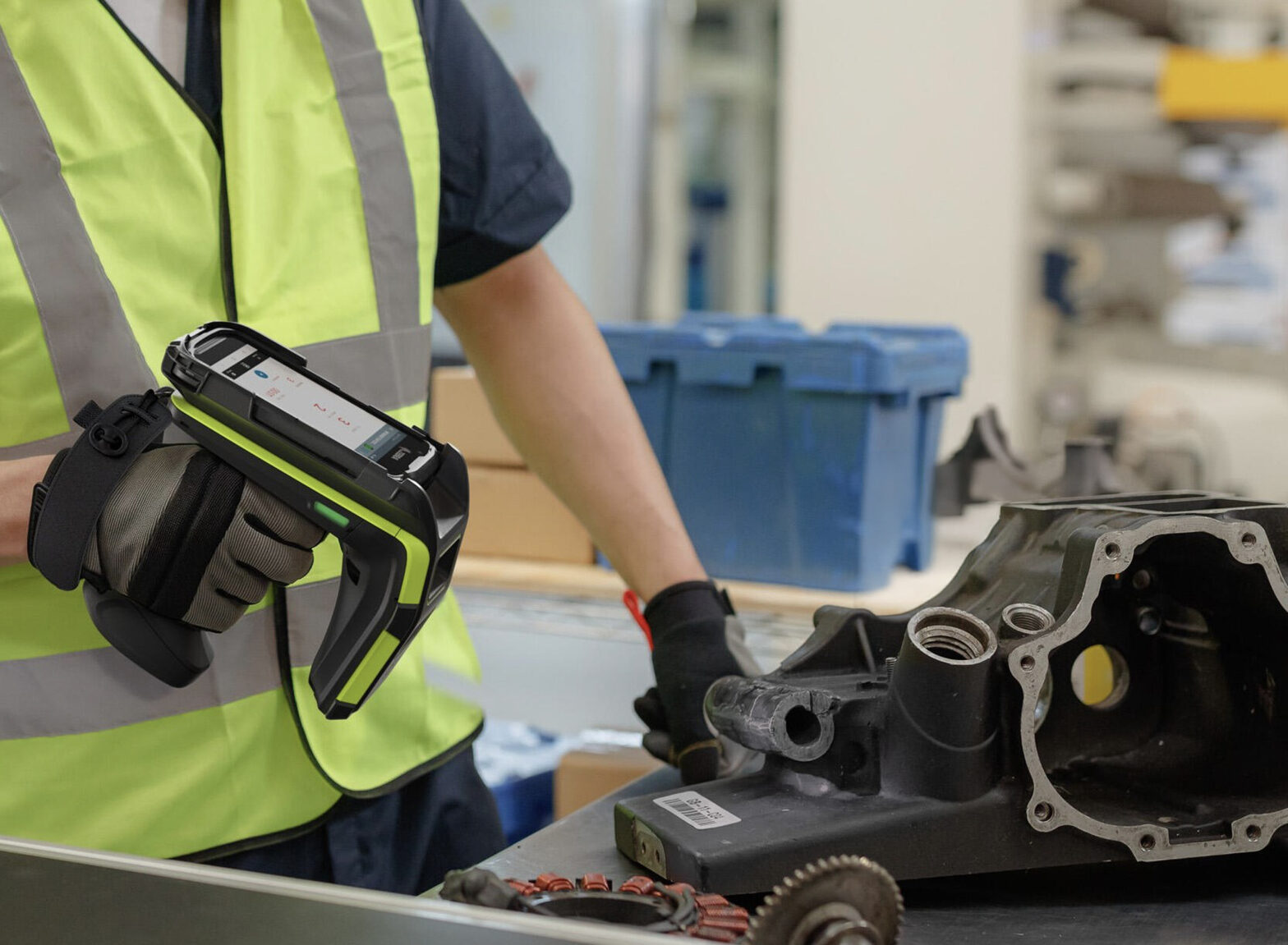
RFID readers (which can be fixed RFID readers or handheld RFID scanners).
RFID antennas, which act as the “intermediate physical bridge” between the reader and the RFID tag.
Why Should RFID Technology Be Applied in Manufacturing?
Accordingly, with traditional management methods, errors are difficult to avoid. Not to mention, data processing speed is slow, labor-intensive, and costly for business operations. Therefore, applying RFID technology in manufacturing is essential if factories and workshops want to optimize operating costs and automate production processes.
Benefits of applying RFID in manufacturing
RFID delivers many practical benefits, specifically as follows:
Automates operational processes and minimizes manual human intervention.
Tracks data in real time, helping businesses make timely strategic decisions and achieve higher management efficiency.
Provides clear and strict traceability, ensuring synchronized and high-quality product batches.
Integrates centralized data systems and automatically transfers data to ERP and MES systems.
How RFID Operates in Manufacturing
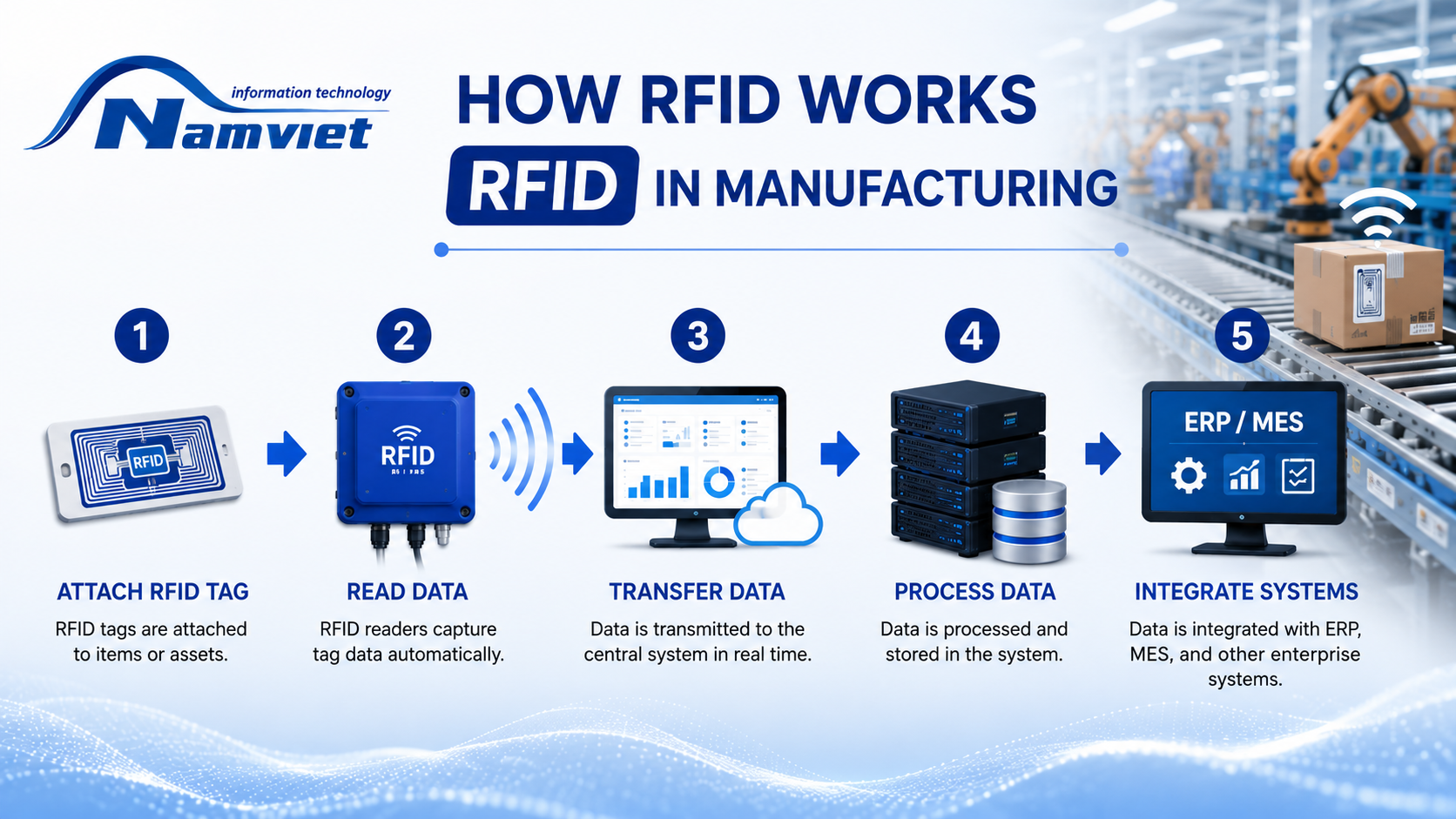
Accordingly, the RFID application process in manufacturing is carried out in a closed-loop, transparent, and fully automated cycle:
How an RFID system operates in manufacturing
Attach RFID tags to the objects being managed (typically raw materials, semi-finished goods, finished products, pallet containers, etc.). Each RFID tag contains a unique identification code along with important information related to the object such as category, model, origin, and more. RFID tags can be hard tags, ABS plastic tags, RFID labels for metal surfaces, and more.
The RFID-tagged object passes through the coverage areas of the fixed RFID reader system installed at key points.
All identification information, location, real-time data, and more are transmitted to the central management software. There, the software directly maps the data into global management platforms such as SAP, Oracle, Microsoft Dynamics, or MES and WMS systems.
Top 7 Common RFID Applications in Manufacturing
RFID is an advanced technology that brings significant benefits to enterprises, factories, workshops, and more. Accordingly, the 7 common RFID applications in manufacturing that you may be interested in include:
RFID Application in Incoming Material Management
There is no need to unload each pallet of raw materials. Simply move the pallet truck through the RFID gate, and the system automatically scans and records the entire batch in just a moment. This process helps businesses automate workflows, eliminate manual counting, reduce losses, and track inventory management accurately. This is also why many businesses are now applying RFID in warehouse management.
RFID Application in Semi-Finished Goods Management
When raw materials enter the production line, fixed RFID readers at each station automatically record the time when semi-finished goods arrive and leave. All production stages such as cutting, machining, assembly, quality inspection, and more are strictly controlled, with accurate data updated in real time.
RFID application in electronics manufacturing
All data is aggregated on a real-time dashboard, allowing managers to see which stage each batch is in, which team is processing it, and the processing time. Applying RFID in semi-finished goods management helps management teams detect bottlenecks early before they affect the entire production line.
RFID Application in Product Traceability
RFID systems are widely applied in traceability and are considered an “electronic logbook” that records product information from raw materials and production stages to finished goods. The data transparency provided by RFID systems helps businesses fully meet international quality management standards such as ISO, HACCP/GMP, and more.
Using RFID in Finished Goods Management
By applying RFID in manufacturing to track materials from warehouse receipt to finished products, the system will contain complete information. When traceability is needed, the entire record can be “published” in just a few minutes. Of course, this helps businesses completely eliminate errors such as shipping the wrong goods or receiving the wrong product category.
RFID Application in Asset and Production Tool Tracking
By applying RFID labels to assets, equipment, and production tools, the system automatically tracks usage frequency and accurately locates each item, thereby issuing periodic maintenance alerts when needed.
RFID Application in Automatic Warehouse Inbound and Outbound Control
The RFID system automatically scans all packages stacked on forklifts as they pass through RFID gates, eliminating manual processes and greatly increasing counting speed and internal logistics efficiency.
RFID Application in Personnel Control and Production Safety
In addition to goods, RFID technology is intelligently integrated into employee cards, enabling management teams to easily control personnel activities, perform RFID-based time attendance, conduct remote monitoring, and more. RFID systems also help improve production safety, prevent unauthorized access, and tightly manage visitor schedules in and out of the factory.
Advantages and Disadvantages of Applying RFID in Manufacturing
Applying RFID in manufacturing offers many outstanding advantages, specifically including:
No need to establish a line of sight; non-contact reading capability.
Data on RFID tags can be changed easily.
Optimizes asset tracking.
Enhances supply chain visibility, providing more detailed visibility into manufacturing operations through real-time updates.
Inventory management and supply chain management become easier and more accurate through RFID systems.
Advantages and disadvantages of RFID in manufacturing
However, compared with barcodes, RFID costs are higher, requiring businesses to have a larger investment budget. This is also why most small businesses today have not yet decided to invest in RFID systems. In addition, RFID systems are more complex than barcodes and require employees to have experience and knowledge in system operation. Therefore, before deciding to deploy RFID in manufacturing, business owners need to calculate carefully in order to optimize ROI effectively.
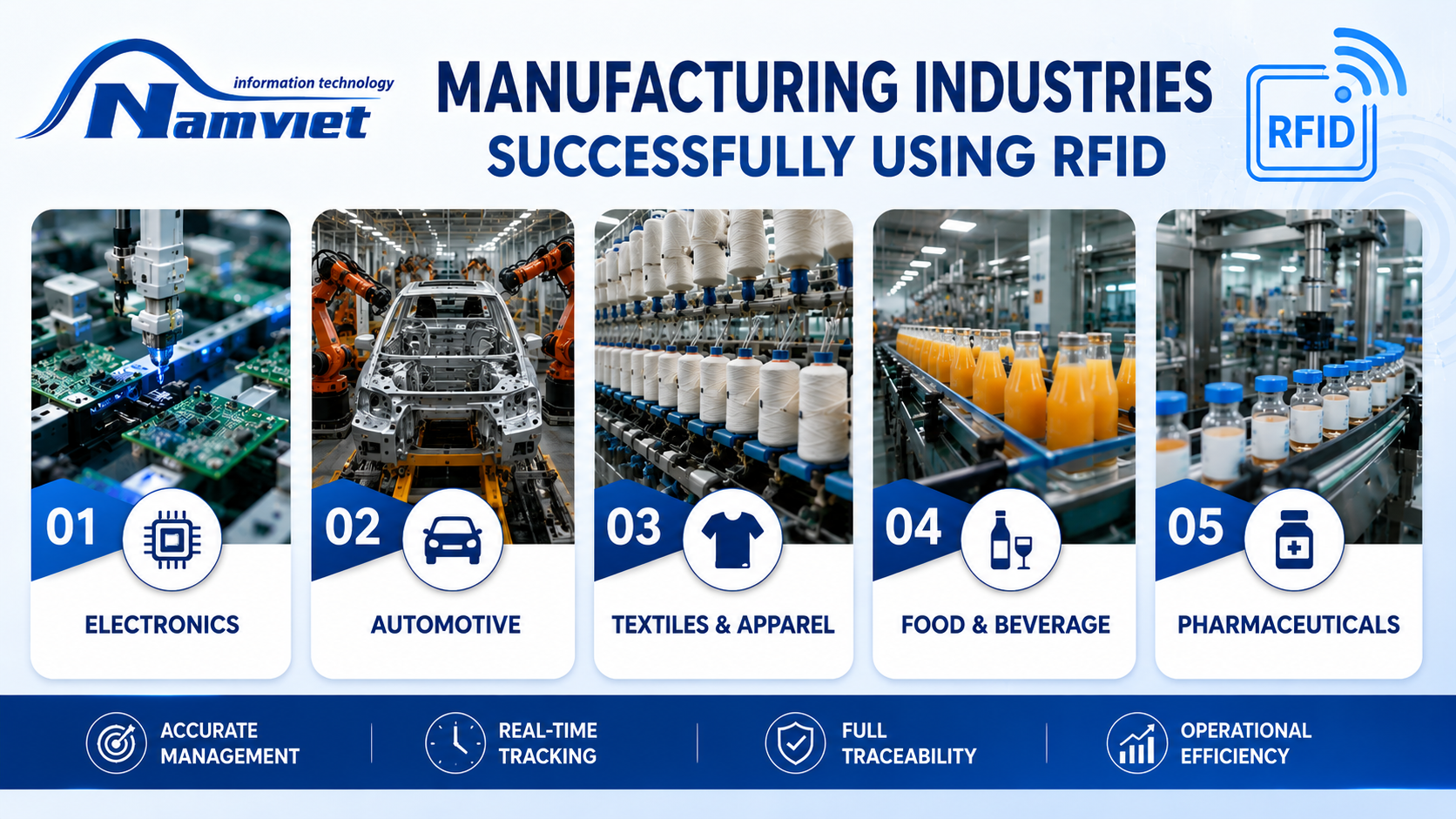
Top 5 Manufacturing Industries That Are Applying RFID Quite Successfully
Currently, with more than 10 years of experience in providing RFID solutions for businesses, IT Nam Viet has found that the top 5 manufacturing industries applying RFID technology quite successfully include:
RFID application in electronics manufacturing to control components, circuit boards, and more.
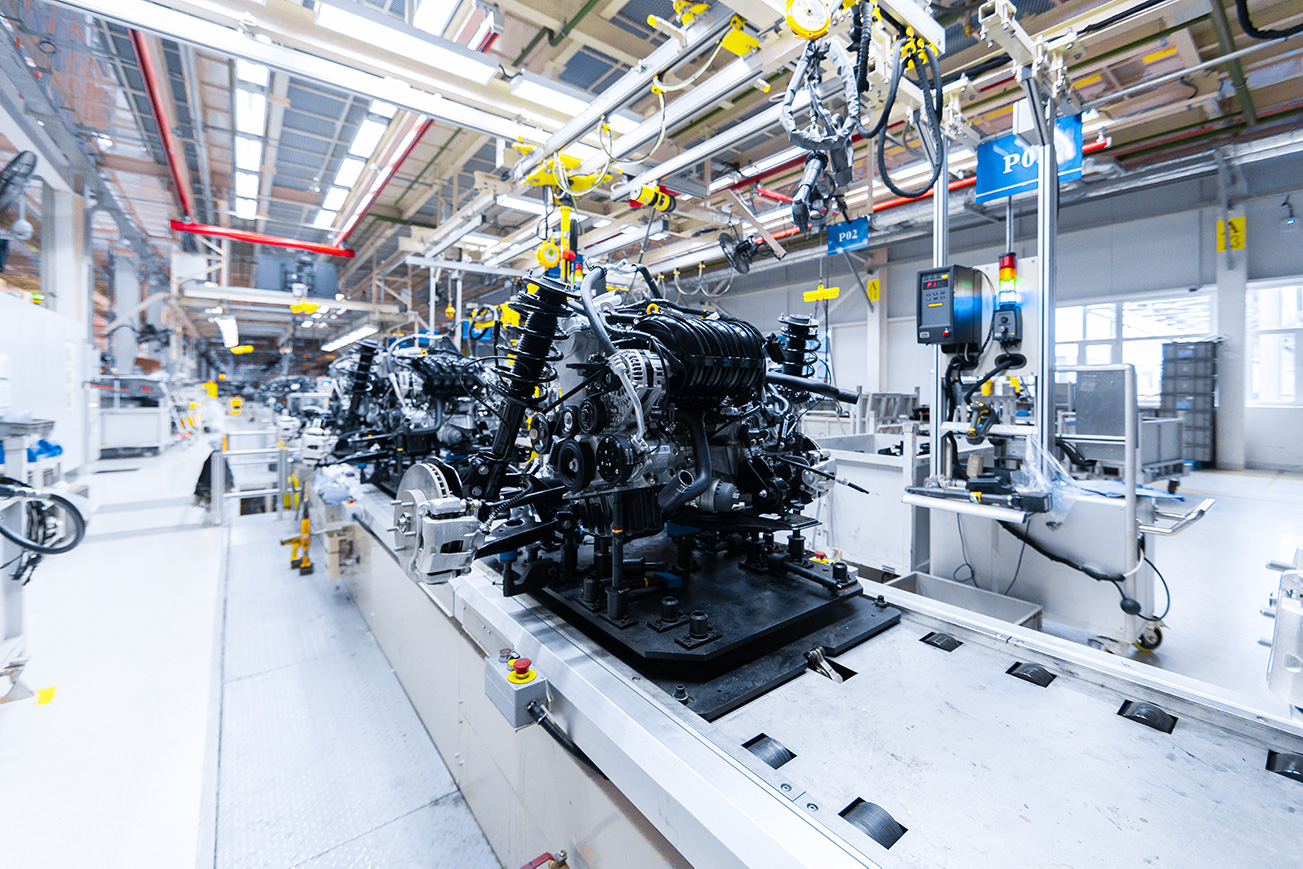
RFID application in automotive manufacturing to manage parts on assembly lines.
RFID application in the textile and garment industry to manage WIP semi-finished goods and balance sewing line productivity.
RFID application in mechanical manufacturing to manage and locate molds.
RFID application in pharmaceutical manufacturing to manage production batches, RFID anti-counterfeiting, and more.
Top 5 Manufacturing Industries That Are Applying RFID Quite Successfully
Key Notes When Choosing an RFID Solution in Manufacturing
To improve the effectiveness of RFID-based production management, you should keep the following basic points in mind:
Choose suitable RFID tags, prioritizing RFID tags that are metal-resistant and waterproof to ensure effective operation in harsh environments.
Pay attention to the RFID reading range and consider selecting a suitable RFID frequency band.
Calculate system scalability and consider combining RFID and AI with IoT connectivity in the future.
Search for and select a reputable RFID implementation provider with many years of hands-on experience across projects of different sizes.
IT Nam Viet – A Professional RFID Provider in Vietnam
IT Nam Viet is proud to be known as one of the providers specializing in complete, comprehensive, multi-industry RFID solutions that meet every strict requirement from investors. We provide free consulting and site surveys, helping customers choose the right solution for each sector, scale, and financial budget.
At IT Nam Viet, we say no to counterfeit, imitation, and poor-quality products. Every device at IT Nam Viet comes with complete documentation, clear origin, and genuine imports from globally renowned brands such as Zebra, Impinj, and more.
IT Nam Viet’s team consists of young professionals with deep RFID expertise across all fields, committed to delivering optimal RFID technology to customers. We implement warranty policies in accordance with regulations and accompany each project for its entire lifecycle. Contact Hotline (+84) 962 888 179 now for consultation!
Not completely, because for some small workshops, applying RFID can be quite complex and costly. Therefore, the optimal choice at this time is still barcodes, with RFID integrated in certain areas where appropriate.
Yes. RFID can be synchronously connected via API to the management systems that businesses and factories are currently using.
Above is information about the application of RFID technology in manufacturing that business owners should refer to. If you need consulting on comprehensive RFID technology, please contact us via Hotline (+84) 962 888 179!
My name is Le Nam Viet, currently FOUNDER & CEO of Nam Viet IT Company, I graduated from Ho Chi Minh Polytechnic University. I have more than 3 years of experience providing RFID chip technology solutions, RFID scanners, barcode labels and barcode readers. It’s a pleasure to share my knowledge with readers.




 Tiếng Việt