Home » News » RFID Technology Applications in the Food Industry | Solutions from IT Nam Viet
RFID Technology Applications in the Food Industry | Solutions from IT Nam Viet
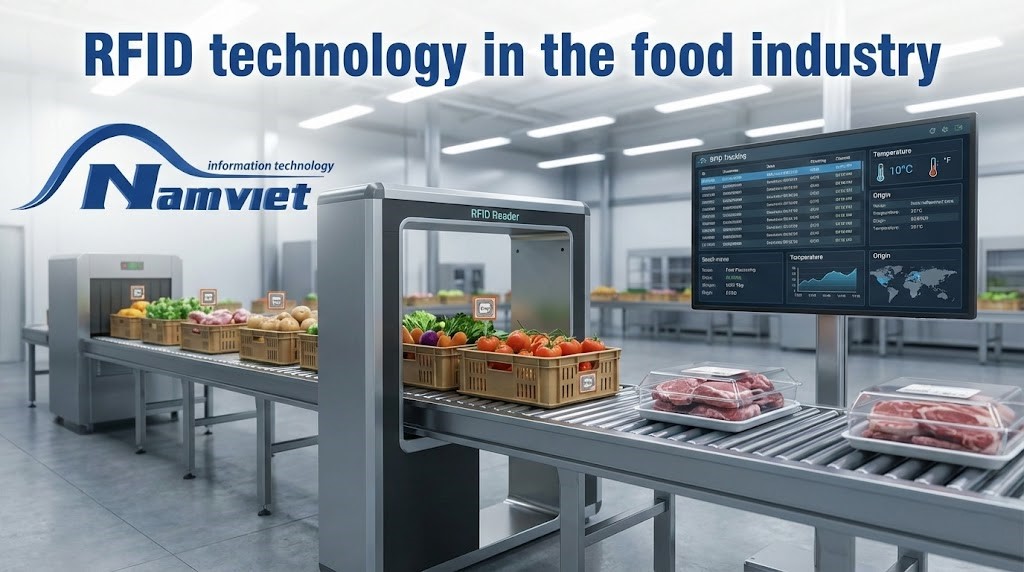
In the food industry, managing millions of items with short shelf lives has created significant operational challenges. Furthermore, consumers’ need to know the origin of products is a major obstacle for supply chain managers. In this context, RFID technology in the food industry has gained trust and application, effectively addressing barriers to loss and inventory management. RFID offers the ability to automate both static and dynamic information flows in real time, providing businesses with a comprehensive overview of their management.
RFID Technology Applications In The Food Industry
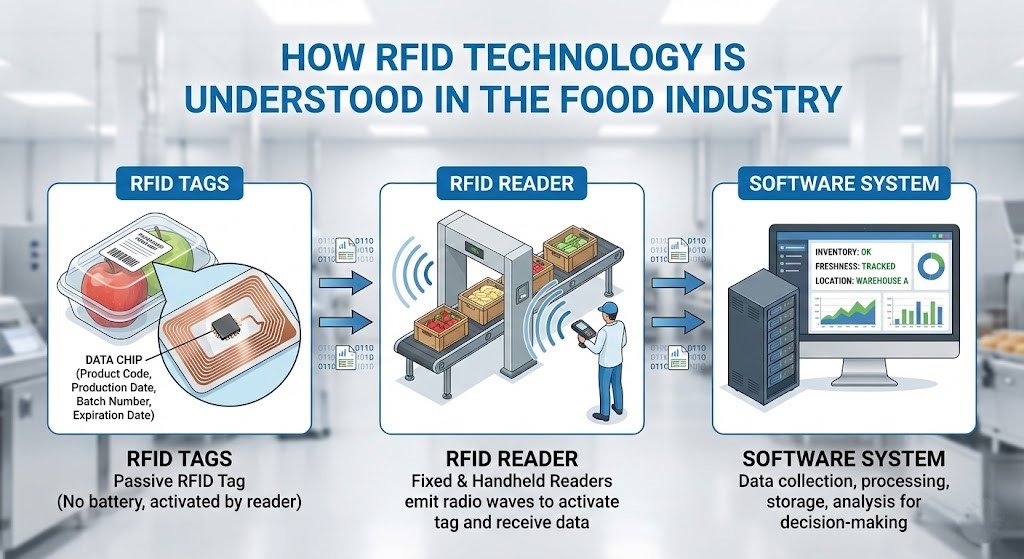
How is RFID technology understood in the food industry?
RFID is a technology that uses radio waves to automatically identify and track RFID tags attached to objects, such as food products. A food-related RFID system includes the following basic components:
RFID tags contain information such as product code, production date, batch number, expiration date, signal transmission and reception antenna, etc. Typically, in the food industry, RFID tags are passive, helping businesses optimize costs effectively.
RFID reader: This can be a fixed RFID reader or a handheld RFID reader, emitting radio waves to activate the tag and receiving data in return.
Software system: After collection, the data is transmitted to a central software system for processing, storage, and analysis, leading to appropriate decision-making.
How is RFID technology understood in the food industry?
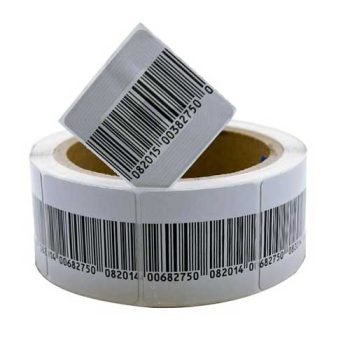
Unlike barcode technology, which requires direct scanning, RFID can read through obstacles such as plastic trays and cardboard boxes. Therefore, with RFID solutions, you can scan an entire pallet of food in an instant without having to unpack it. This is also the advantage that makes RFID technology different and superior.
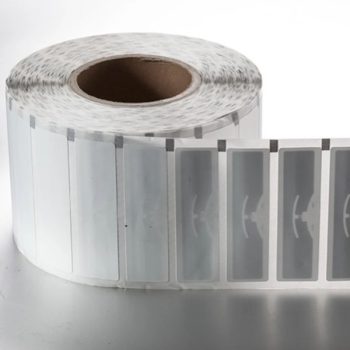
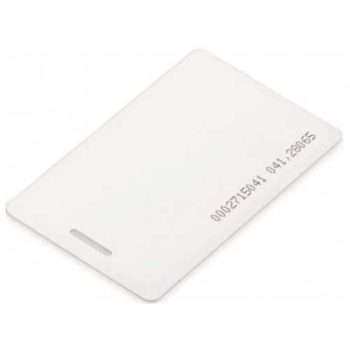
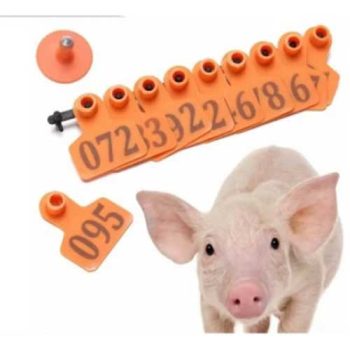
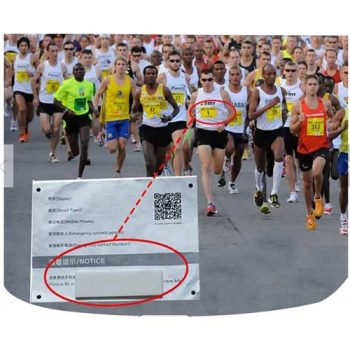
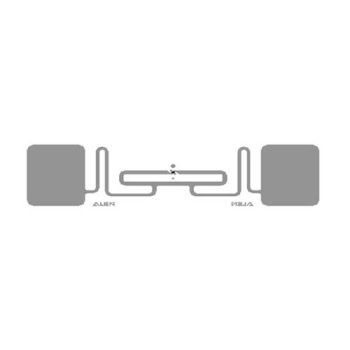
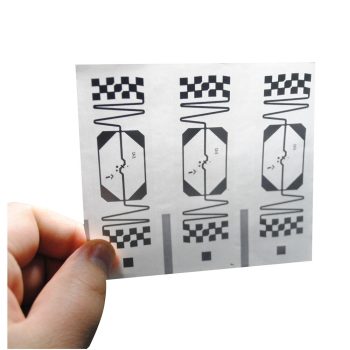
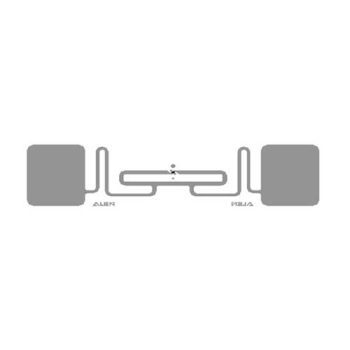
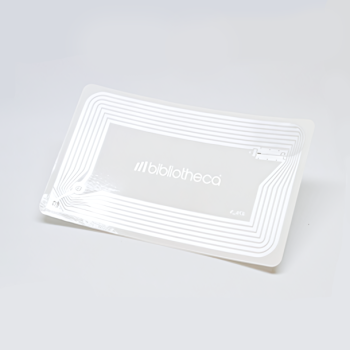
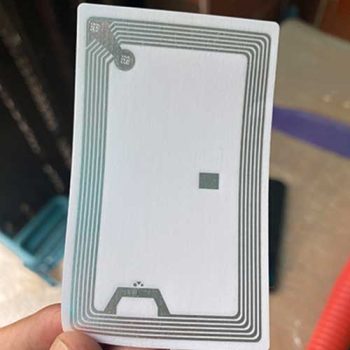
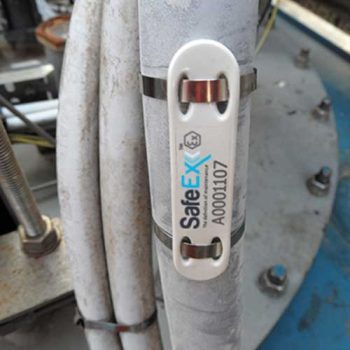
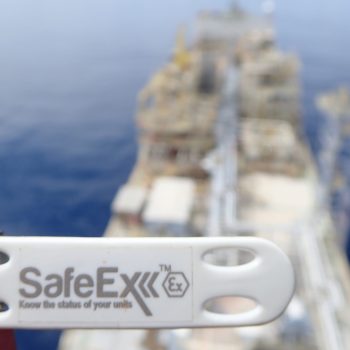
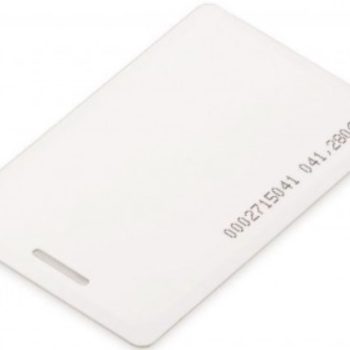
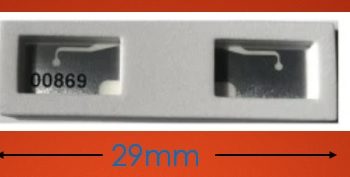
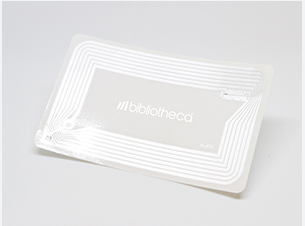
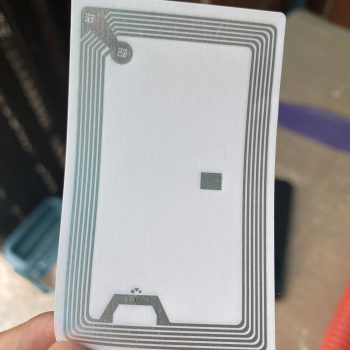
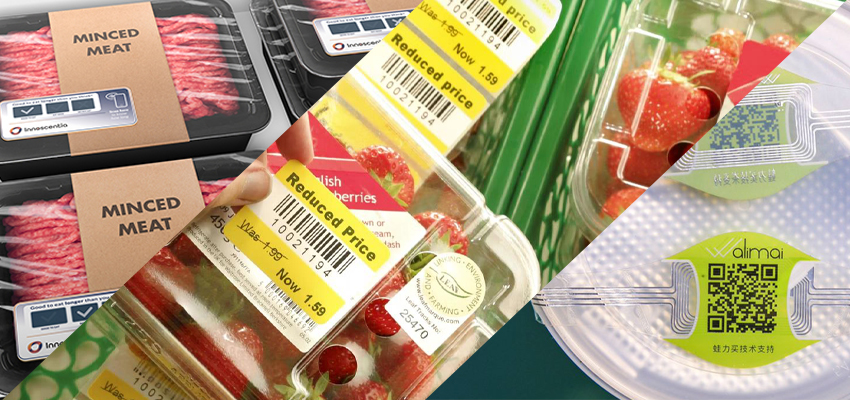
Accordingly, the types of RFID tags and labels commonly used in the food industry include: waterproof RFID tags, metal-resistant RFID tags, etc. IT Nam Viet specializes in manufacturing RFID labels according to customer requirements, allowing customers to choose the RFID chip type, size, and antenna to suit their needs.
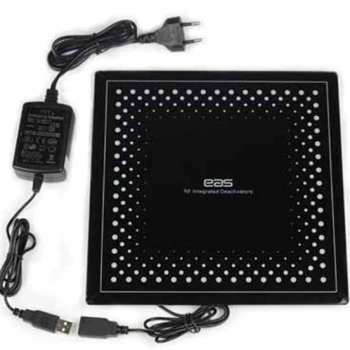
Please refer to the types of RFID tags and RFID labels below:
Why Do Businesses Need to Upgrade from Barcode to RFID in Food Management?
Currently, many businesses still use barcode technology and believe it’s “sufficient.” While this is true, it’s only applicable to small-scale operations and not to large-scale supply chain systems.
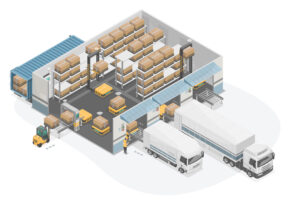
With barcode technology, manual scanning is time-consuming and costly. In contrast, with RFID technology, a forklift simply drives through an RFID reader installed in the warehouse, and within 1-2 seconds, the system instantly captures all 500 IDs of the milk cartons, automatically matching them with the warehouse receipt on the software.
Besides simultaneously reading hundreds of products in 1-2 seconds, RFID technology helps businesses minimize human error, eliminating the risk of duplicate or undercounting. This means that RFID systems automate inventory tracking, significantly reducing manual workload.
On the other hand, barcode labels are usually printed with thermal ink, and in the cold storage environment of food, the labels are easily smudged and scratched during handling. Conversely, when applying RFID in cold storage management, RFID labels are highly durable, and radio waves can penetrate fog and snow, ensuring data continuity throughout the product’s lifecycle.
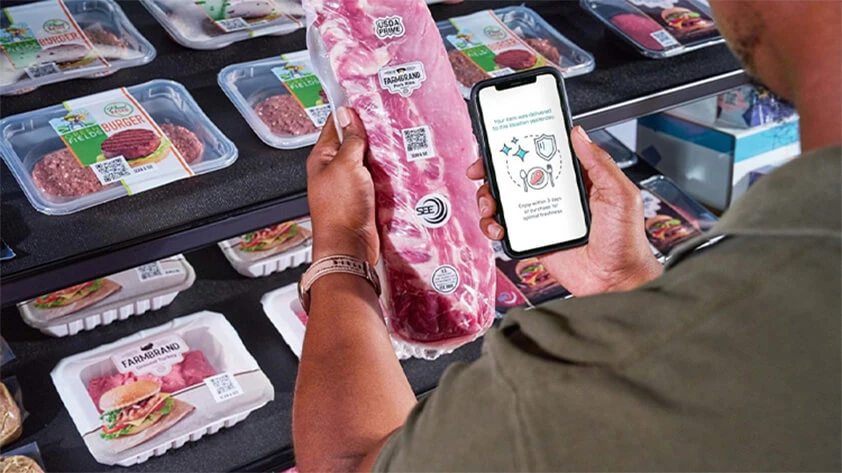
Especially with RFID technology, consumers can access information related to food such as the place of production, batch number, and production date. This helps businesses build trust with consumers and demonstrates their commitment to product quality.
Application of RFID Technology in the Food Industry
Here are some applications of RFID technology in the food industry that you can refer to:
RFID applications for managing food inventory and expiration dates
In the food industry, expiration dates are a matter of life and death. Experience has shown that some traditional technologies are sometimes inaccurate, with later shipments having shorter expiration dates than earlier ones. This has forced modern F&B businesses to switch to RFID technology for inventory management.
RFID tags will be attached to pallets containing product codes, including production and expiration dates. During storage, the software system will automatically create a heat map of the warehouse, scanning and tracking the lifespan of each pallet. When goods are dispatched, the software automatically assigns the exact location of the pallet with the nearest expiration date for forklift pickup. This effectively minimizes inventory buildup.
RFID applications in transparent food traceability
With modern life, consumer behavior has changed. Consumers are willing to pay higher prices for products with clear origins. Furthermore, to export to demanding markets (USA, EU, Japan) or to obtain international certifications (VietGAP, GlobalGAP, HACCP), traceability is a mandatory requirement.
Food traceability using RFID technology
Raw materials are tagged with RFID tags, recording harvesting information.
At the processing plant, RFID tags track raw materials through each stage, from preliminary processing and mixing to packaging.
During transportation, linked with temperature sensors, goods are always ensured to meet standards.
Upon reaching consumers, they simply scan the QR code to view all relevant food information.
RFID in combating food counterfeiting
Currently, several high-end food products are being counterfeited, such as bird’s nest, cocoa, imported liquor, and dietary supplements. This significantly impacts the reputation and revenue of legitimate businesses. Furthermore, anti-counterfeiting labels and barcodes are also being easily faked.
Application of RFID technology in combating counterfeit food.
With RFID anti-counterfeiting technology, each chip is assigned a unique identifier from the moment it leaves the factory. According to experts, RFID tags are secure, highly reliable, and difficult to copy or counterfeit using other technologies. Therefore, consumers can easily check whether a product is genuine or fake.
IT Nam Viet – A Reputable RFID Supplier for the Food Industry
IT Nam Viet is proud to be a reputable provider of RFID solutions in Vietnam for supply chains, logistics, retail, and more. Our team of engineers possesses in-depth knowledge of RFID frequency bands, specialized expertise, and dedication to project management, committed to providing customers with high-quality RFID systems at reasonable prices.
RFID labels in the food industry
We are strategic partners with leading global RFID equipment manufacturers such as Zebra and Impinj, ensuring the supply of durable RFID readers and high-quality RFID tags with full food contact safety certifications.
Workflow at IT Nam Viet:
Receive and conduct on-site surveys.
Consult on RFID technology solutions suitable for your needs, scale, budget, etc.
Deploy and integrate the RFID system.
Handover, training on RFID application, and warranty according to regulations.
Investing in RFID technology for the food industry is no longer a luxury expense, but a highly profitable investment strategy. By eliminating near-expired goods, automating inventory checks, optimizing human resources, and building customer trust, RFID provides businesses with a significant competitive advantage. Don’t hesitate, contact IT Nam Viet today for a consultation and survey to find the right RFID solution for your budget and business scale.
YES, RFID systems are still being used in cold storage management; the tags meet industrial standards and withstand extremely low temperatures. RFID works well even in icy and snowy environments.
YES, RFID labels supplied to the F&B industry are guaranteed to meet international food safety standards, are non-toxic, and do not leach through plastic packaging.
RFID costs depend on many factors, including hardware, software, RFID tags, and related service fees. Therefore, the cost of deploying RFID in the food industry does not have a fixed figure. Although the initial investment cost is higher than barcodes, in the long run, RFID offers huge benefits by completely eliminating manual inventory counting costs, preventing the need for goods to expire (FEFO) and be destroyed, and minimizing product loss.
RFID deployment time depends on the scale and complexity of the software system the business is using. Typically, a medium-sized project will involve 2-3 weeks of site survey and testing, followed by another 1-2 months for equipment installation, programming, and personnel training.
IT NAM VIET TRADING AND SERVICE COMPANY LIMITED
Company address: 177/22 National Highway 1K, Linh Xuan Ward, Ho Chi Minh City
Showroom and office address: 88 Street No. 15, Van Phuc Urban Area, Hiep Binh Ward, Ho Chi Minh City
Hotline: (+84) 962 888 179
Branch in Cambodia: No. 6 Street 24BT, Thnaot Chrum, Boeung Tumpun 2, Khan Mean Chey, Phnom Penh
My name is Le Nam Viet, currently FOUNDER & CEO of Nam Viet IT Company, I graduated from Ho Chi Minh Polytechnic University. I have more than 3 years of experience providing RFID chip technology solutions, RFID scanners, barcode labels and barcode readers. It’s a pleasure to share my knowledge with readers.



 Tiếng Việt